

Barclays Bank is a leading co-branded credit card issuer and financial services partner in the United States. The bank offers co-branded credit cards, small business credit cards, installment loans, POS Finance, online savings accounts, and CDs.
Although it was last reported in 2021, Barclay stands as the 9th largest bank in terms of total outstanding credit card balance. According to WalletHub.com, Barclay card consumers have a total of $22.12 billion of credit card debt. This represents about 2.37% of the total market share.
What are your options to pay back your Barclays credit card debt?
Facing a large amount of credit card debt and/or personal loans can be frightening. It’s a constant reminder that we messed up. And chances are neither your formal education nor your parents prepared you on how to handle this situation.
However, there are many debt consolidation options to consider when trying to pay back your Barclays credit card debt. The five main options are:
- Debt Consolidation Loan
- 0% Balance Transfer
- Barclays Internal Hardship Program
- Debt Management Plan (Credit Counseling)
- Debt Settlement Plan
But the one thing that must be done regardless is putting a stop to overspending. Each time we use a credit card we purchase something we can’t afford.
Create a detailed budget outlining all income and all expenses. Revisit this budget periodically and make revisions. Increase income. And decrease expenses.
Barclays Credit Card Hardship Program
If you find yourself struggling with credit card debt, hardship programs can help. In order to find out if you qualify, contact Barclays directly. Provide as many details as possible about your financial situation. Be prepared to provide them with your monthly income and expenses. Stating that you are simply looking for a lower interest rate and payments probably won’t work. You must have a compelling hardship such as job loss or medical emergency to qualify.
Any concessions granted by Barclays will typically be temporary. A lower interest rate will likely last less than 12 months. Take advantage of that time and attack your debt with extra payments. Some creditors might reduce your credit limit or even close your card once they approve you on their hardship plan.
If you have no luck getting concessions or want more long-term benefits, credit counseling is your next best option. Barclays works incredibly well with these nonprofit organizations. They offer clients interest rates usually below 5%. Payments typically get lowered as well. Your credit card will be closed on their debt management program. This can be viewed as a good thing for some as the temptation to continue using the card is eliminated.
DebtWave has been helping Barclays clients for more than 20 years
DebtWave has worked with various credit card accounts, including Barclays, since 2002 helping clients pay off debt at lower interest rates. Most clients add other credit cards to their plan such as American Express, Comenity Bank and Chase. Clients make payments via ACH either monthly, semi-monthly, weekly or biweekly and then DebtWave disburses payments to their creditors. Most clients complete their program and become debt free in less than 5 years. DebtWave has a 68% successful completion rate.
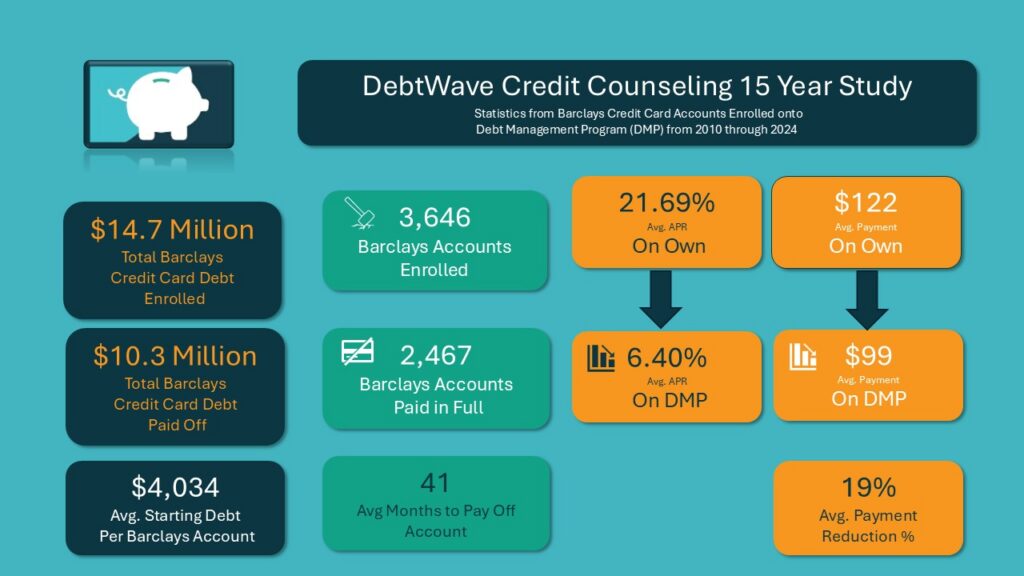
From 2010 to 2024, DebtWave helped clients with a total of 3,646 Barclays accounts. The total debt enrolled onto our program during that time was $14.7 million with an average balance of $3,646 per account. Many clients witnessed their interest rates drop below 7% along with a reduction in monthly payments.
Here are some additional stats from these clients:
The Dream of Getting Out of Debt on Your Own is Possible
Paying back your credit card debt seems like an daunting task. But it has proven to be achievable by thousands of DebtWave clients. If you would rather tackle the debt on your own, it can be achieved. Create your own plan. The first step is lower interest rates. High interest rates (25-30% APR) on credit cards makes it very difficult. This would require you to double or triple your minimum payments to make progress.
If you have your rates reduced to less than 10%, then use a payoff calculator or google spreadsheet to create a plan. Stay motivated and refrain from using cards again. Build an iron clad budget. Include all expenses and income sources. Then stick to the budget. Decrease expenses. Increase Income. Seek credit counseling if necessary.
Accordions
Barclays offers assistance for cardholders experiencing financial difficulty, although the specific options available can depend on your account and financial situation. Barclays maintains a financial-hardship option within its card-servicing system, and customers can contact Barclays directly to find out what assistance may be available.
If you're struggling with a Barclays credit card payment, it's usually better to ask about assistance before you begin missing payments.
Contact Barclays and explain that you're having difficulty making your credit card payments and would like to discuss financial hardship or payment-assistance options.
Be prepared to discuss your financial situation, including your income, essential monthly expenses and what you can realistically afford to pay toward the account.
Barclays provides customer support through its website and account-servicing channels.
Before accepting an offer, ask Barclays:
- What will my new monthly payment be?
- Will my interest rate change?
- How long will the arrangement last?
- Will late fees or other fees be waived?
- Will my credit card be closed or restricted?
- How will the account be reported to the credit bureaus?
Knowing those details makes it easier to compare Barclays' offer with other debt-relief options.
It depends on your situation.
A Barclays hardship program may make more sense if Barclays is your primary credit card debt and the payment assistance they offer solves your immediate problem.
A debt management program may be worth considering if you have:
- Multiple high-interest credit cards
- Debt with Barclays plus other creditors
- Monthly payments that are becoming difficult to manage
- Interest charges that are making it difficult to reduce your balances
- A need for a longer-term, structured repayment strategy
Rather than choosing based only on the lowest initial payment, compare the interest rate, monthly payment, repayment period and total estimated cost of each option.
Possibly. The assistance available will depend on your account and the options Barclays offers when you contact them.
If Barclays offers you a reduced interest rate, find out whether the rate is temporary or applies until the balance is repaid. You should also ask what happens to your interest rate after the hardship period ends.
If the rate or payment offered by Barclays still isn't affordable, a nonprofit debt management program may be another option to investigate.
It may. Hardship arrangements are generally intended to make an account more manageable when the normal payment has become difficult to afford.
However, your actual payment will depend on the terms Barclays offers for your account.
Before enrolling, compare the proposed payment with your monthly budget. A lower payment isn't particularly helpful if it is still more than you can consistently afford.
The effect can depend on how Barclays handles your particular account and how the arrangement is reported.
Ask Barclays specifically whether participation will be reported to the credit bureaus and whether your credit limit or account status will change.
Your payment history is also important. Missing credit card payments can negatively affect your credit, so contacting the creditor before falling significantly behind may give you more options.
It's possible that access to the card could be restricted or that the account could be closed as part of a hardship arrangement, depending on the terms you're offered.
Don't assume that you'll be able to continue charging purchases to the card. Ask Barclays what will happen to the account before agreeing to the plan.
For consumers trying to get out of credit card debt, closing or restricting the card can also remove the temptation to continue adding to the balance.
You should still contact Barclays even if you've already missed a payment.
The assistance available may depend on the status of your account, so the sooner you contact Barclays, the better. Explain what caused the financial difficulty, whether your situation is temporary or ongoing, and what payment you believe you can afford.
Don't intentionally stop making payments simply because you're hoping to qualify for a hardship program.
A hardship program should not be confused with debt forgiveness or debt settlement.
Hardship assistance is generally designed to make repayment more manageable rather than erase the balance you owe. If you're offered a hardship arrangement, make sure you understand the amount you will ultimately repay, the interest rate and the required monthly payment.
Debt settlement is a different debt-relief strategy and can have very different consequences than either a hardship program or a nonprofit debt management program.
If the payment Barclays offers still doesn't fit your budget, consider reviewing your entire financial situation rather than focusing on one credit card.
This is especially important if you owe money to several credit card companies.
A nonprofit credit counseling agency can review your income, expenses and unsecured debts and help determine whether a debt management program (DMP) may provide a more sustainable repayment strategy.
DebtWave reports having worked with 3,646 Barclays accounts between 2010 and 2024 through its debt management program.
Barclays accounts may be eligible for inclusion in a debt management program.
DebtWave has worked with thousands of Barclays accounts through its debt management program. With a DMP, participating creditors may provide benefits such as reduced interest rates or monthly payments, depending on the creditor and account.
Instead of making separate payments to each creditor enrolled in your plan, you make your scheduled payment to the credit counseling agency, which distributes payments to your participating creditors. DebtWave's debt management programs are generally designed to help consumers repay enrolled credit card debt within approximately three to five years.
Yes. You can complete a credit counseling session with DebtWave to review your credit card debt, income and monthly expenses.
The credit counseling session itself is free. If a debt management program is appropriate, a counselor can explain the estimated payments, creditor benefits, fees and payoff timeline before you decide whether to enroll. DebtWave states that enrollment fees and monthly DMP fees vary based in part on the client's state of residence.
If you're struggling with Barclays debt as well as other credit cards, reviewing all of your accounts together can help you determine whether dealing with Barclays individually or using a broader debt management strategy makes more sense.
Get a free debt analysis from DebtWave to see what your Barclays payment and interest rate may look like on a debt management program.
