
Can a CareCredit Hardship Program Help With Credit Card Payments?
A CareCredit hardship program or other payment-assistance arrangement may be worth exploring when medical, dental, veterinary or other healthcare expenses have left you with a CareCredit balance that has become difficult to manage.

Nonprofit Credit Counseling Since 2001
How to Ask About a CareCredit Hardship Program
How Does a CareCredit Hardship Program Work?
3 Questions to Ask About the CareCredit Hardship Program
What Will My New Payment Be?
Confirm the required payment, when it begins and whether it changes during or after the arrangement.Will My APR or Fees Change?
Ask whether interest rates, late fees or other account terms change while you participate in the arrangement.What Happens to My Promotional Balance?
If you have deferred-interest financing, confirm whether the hardship arrangement affects the promotional expiration date, accrued interest or payment allocation.Understand CareCredit Deferred Interest Before Changing Payments
6–24 Month Deferred Interest
Qualifying purchases may receive deferred-interest periods of 6, 12, 18 or 24 months.Pay the Promo Balance in Full
The entire promotional balance generally must be paid by the expiration date to avoid the accrued promotional interest.Standard APR Can Be High
CareCredit currently discloses a 32.99% APR for new accounts. Existing cardholders should check their own agreement for the APR that applies to them.
Three Ways to Address CareCredit Debt
Work Directly With CareCredit
If CareCredit is the primary account causing difficulty, contact CareCredit and ask whether account-specific payment assistance is available.Pay the Balance Yourself
If your budget allows larger payments, calculate whether increasing your payment could eliminate the balance before a promotional deadline or reduce future interest costs. Calculate Your Payoff Time →Review a Debt Management Program
If CareCredit is one of several high-interest credit cards, nonprofit credit counseling may provide a coordinated repayment strategy for eligible accounts.When a CareCredit Hardship Program May Not Be Enough
CareCredit Hardship Program or a Debt Management Program?
DebtWave's Experience With Synchrony Bank Accounts
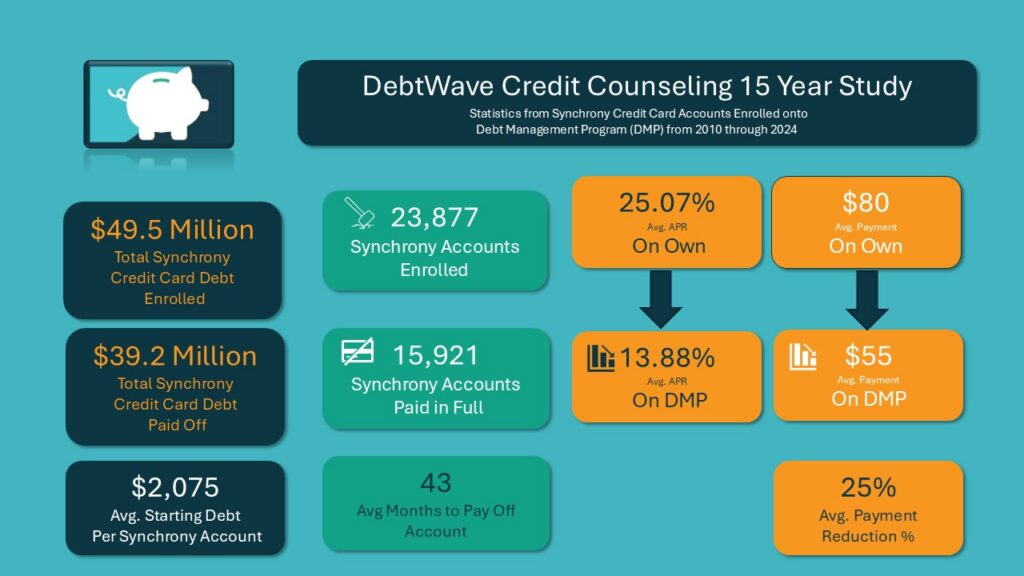
Historical DebtWave analysis of Synchrony Bank accounts enrolled from 2010 through 2024. These statistics reflect Synchrony accounts broadly and are not limited to CareCredit. Historical averages and outcomes do not guarantee future CareCredit or Synchrony terms or individual results.
CareCredit Hardship Program vs. a Debt Management Program
| Feature | CareCredit Assistance | Debt Management Program |
|---|---|---|
| Who provides it? | CareCredit / Synchrony Bank | Nonprofit credit counseling agency |
| Accounts addressed | Individual CareCredit account | Multiple eligible participating creditors may be included |
| New loan required? | No | No |
| Payment changes? | Depends on account-specific assistance offered | Depends on participating-creditor guidelines |
| APR changes? | Confirm directly with CareCredit | Eligible creditors may provide reduced APRs |
| Promotional financing? | Existing promotional terms may be important | Review promotional balances before enrollment |
| Budget and debt review? | Not the primary purpose | Included in the nonprofit counseling process |
| Multiple creditors? | Focused on CareCredit | Multiple qualifying accounts may be coordinated |
Estimate Your CareCredit DMP Payment and APR
Why Consider DebtWave instead of CareCredit Hardship Program?

NFCC Member Agency
DebtWave is listed in the National Foundation for Credit Counseling member-agency directory.Care Credit Hardship Program FAQs
Does CareCredit have a hardship program?
CareCredit does not publicly advertise one standard hardship program with identical terms for every cardholder. If payments have become difficult, contact CareCredit and ask whether hardship assistance, payment assistance or another repayment option is available for your account.What is the CareCredit hardship phone number?
CareCredit currently lists 866-893-7864 for existing cardholders. You can also use the customer-service number printed on the back of your card.Who issues the CareCredit credit card?
CareCredit is issued by Synchrony Bank. Therefore, account documents, payments and creditor-program information may reference Synchrony Bank.Should I contact CareCredit before missing a payment?
If you believe you may have difficulty making an upcoming payment, contacting CareCredit early can give you time to ask what account-specific options may be available.Can CareCredit lower my monthly payment?
Any CareCredit minimum payment help depends on the particular account and assistance Synchrony makes available. A reduced monthly payment is not guaranteed for every cardholder.Can a CareCredit hardship program lower my interest rate?
Do not assume that an interest-rate reduction will be offered. If CareCredit provides an account-specific arrangement, ask whether the APR changes and how long any modified terms remain in effect.What is CareCredit deferred interest?
Certain qualifying CareCredit purchases may receive a "No Interest if Paid in Full" promotion. Interest accrues during the promotional period but is not charged if the qualifying balance is completely paid before the promotional expiration date.Is CareCredit deferred interest the same as 0% APR?
No. With deferred interest, interest accrues from the original purchase date. If the promotional balance is not paid in full before the promotional deadline, the accumulated interest may be charged to the account.What happens if I have $1 left when my promotion expires?
CareCredit explains that even a small remaining promotional balance may cause the accrued deferred interest to be added to the account. Review the specific terms of your promotion and billing statement.Is the CareCredit APR really 32.99%?
CareCredit currently discloses a 32.99% purchase APR for new accounts. Existing cardholders should review their own credit-card agreement because the rate applicable to an existing account may differ.Can CareCredit be included in a Debt Management Program?
Eligible CareCredit accounts may be able to participate in a nonprofit Debt Management Program. Participation, interest rates, payments and other concessions depend on the individual account and Synchrony's current creditor guidelines.Will my CareCredit card be closed on a DMP?
Credit card accounts enrolled in a Debt Management Program are generally closed or restricted from additional purchases. This is particularly important if you currently rely on CareCredit for medical, dental or veterinary expenses.Does CareCredit have a debt-forgiveness program?
CareCredit does not publicly advertise a standard program that automatically forgives balances because a cardholder is experiencing financial hardship. Hardship assistance, debt management and debt settlement are different approaches.Is a CareCredit DMP the same as a consolidation loan?
No. A traditional Debt Management Program does not replace your CareCredit balance with a new loan. Instead, eligible participating debts are repaid through a structured program administered by a credit counseling organization.What if I have CareCredit plus several other credit cards?
A nonprofit credit counseling session can review several unsecured creditors together. This may be especially useful when CareCredit represents only one portion of a larger monthly credit card debt burden.How can I estimate a CareCredit DMP payment?
Use DebtWave's Debt Management Plan Calculator to compare your current balances, payments and APRs with estimated program terms. Actual CareCredit and Synchrony terms may differ from the estimate.Is there a CareCredit debt cancellation program?
CareCredit does not offer a general debt cancellation program that simply eliminates your outstanding balance because you are having difficulty making payments. However, CareCredit accounts are issued by Synchrony Bank, which offers an optional Payment Security Debt Cancellation Program for eligible cardholders who enrolled in the protection. Depending on the terms of the coverage, benefits may be available after certain qualifying events such as involuntary unemployment, disability, hospitalization, nursing home care, terminal illness, or death. Restrictions and eligibility requirements apply.
If you are struggling with CareCredit debt and do not have this coverage, you may still have other options. Synchrony offers hardship and account-modification programs for some borrowers experiencing financial difficulty. Depending on your circumstances, these programs may reduce interest, fees, or payments. Another option is a nonprofit Debt Management Program, which may provide a reduced interest rate and a structured monthly payment while allowing you to repay the CareCredit balance in full.
Important: Debt cancellation, debt settlement, a creditor hardship program, and a Debt Management Program are different types of assistance. Contact CareCredit/Synchrony directly to determine what options are currently available for your account.