
CHASE HARDSHIP PROGRAM
Can a Chase Hardship Program Help With Credit Card Payments?
If you are searching for a Chase hardship program, Chase currently directs existing card customers to ask about its Card Payment Assistance Programs by calling the number on the back of their credit card. Available options can depend on the account and the customer's financial circumstances.
However, Chase may be only one part of your debt. If several high-interest credit cards are putting pressure on your budget, nonprofit credit counseling can help you review the complete financial picture and compare repayment strategies.

Nonprofit Credit Counseling Since 2001
How to Ask About a Chase Hardship Program
Chase currently lists Card Payment Assistance Programs as a resource for existing Chase card customers. The bank instructs cardholders to call the number on the back of their card to learn more about assistance that may be available.
If you do not have the card available, Chase lists 800-432-3117 as its general credit card customer service number.
Chase directs existing card customers to the number on the back of the card for Card Payment Assistance Programs.
Chase's published general customer service number for credit card accounts.
Chase also publishes information about debt repayment, credit counseling and debt management options.
How Does a Chase Hardship Program Work?
Chase publicly refers customers to Card Payment Assistance Programs rather than publishing one universal hardship plan with identical terms for every cardholder. Therefore, you should speak directly with Chase about the options available for your specific account.
A creditor repayment arrangement may involve different payment terms depending on the situation. Because Chase does not publish one guaranteed hardship APR, payment reduction or program duration for every account, confirm the details before agreeing to any arrangement.
Before accepting assistance: Ask what your new payment will be, whether the APR or fees change, how long the arrangement lasts, what happens to the card and what terms apply after the assistance period ends.
3 Questions to Ask About a Chase Hardship Program
A Chase hardship program or another payment arrangement may provide short-term breathing room. Even so, the complete terms matter when you are deciding whether the offer fits your budget and repayment goals.
What Will My Payment Be?
Confirm the required monthly amount, the first payment date and whether the amount changes later.
What Happens to My APR?
Ask whether your interest rate or fees change and whether any modified terms are temporary.
What Happens to My Card?
Find out whether you can continue using the card or whether Chase will restrict or close the account.
A Chase Hardship Program and Other Ways to Address Credit Card Debt
Your best approach depends on your balance, APR, monthly cash flow and whether Chase is your only major credit card debt or one of several accounts.
Work Directly With Chase
If one Chase card is the main problem, ask Chase about its Card Payment Assistance Programs and any account-specific options.
Continue Paying on Your Own
If your budget supports larger payments, calculate whether you can repay the balance independently within a reasonable period.
Review a Debt Management Program
When several high-interest cards strain your budget, a nonprofit DMP may provide a coordinated approach for eligible participating accounts.
When a Chase Hardship Program May Not Be Enough
A Chase hardship program may improve one account without fixing a larger monthly cash-flow problem. If you also owe money to other high-interest creditors, nonprofit credit counseling can help you review those balances together.
Chase Hardship Program or a Debt Management Program?
If a Chase hardship program does not address your overall debt situation, nonprofit credit counseling may provide another path. Chase's own educational materials explain that credit counselors can review a consumer's finances and may recommend a Debt Management Plan.
Under a DMP, eligible participating accounts may receive reduced interest rates, waived fees or other creditor concessions. Qualifying clients generally make one scheduled program payment, and the counseling agency distributes the appropriate amounts to participating creditors.
A traditional Debt Management Program is not a new consolidation loan. Instead, the program is designed to repay enrolled balances through a structured plan without borrowing additional money.
Chase participation and final terms depend on the individual account and current creditor guidelines. As a result, a particular APR, payment or repayment period cannot be guaranteed.
DebtWave's Experience With Chase Credit Card Accounts
DebtWave analyzed Chase credit card accounts enrolled in its Debt Management Program from 2010 through 2024. These historical figures show what occurred within that group, although future creditor terms and individual outcomes can differ.
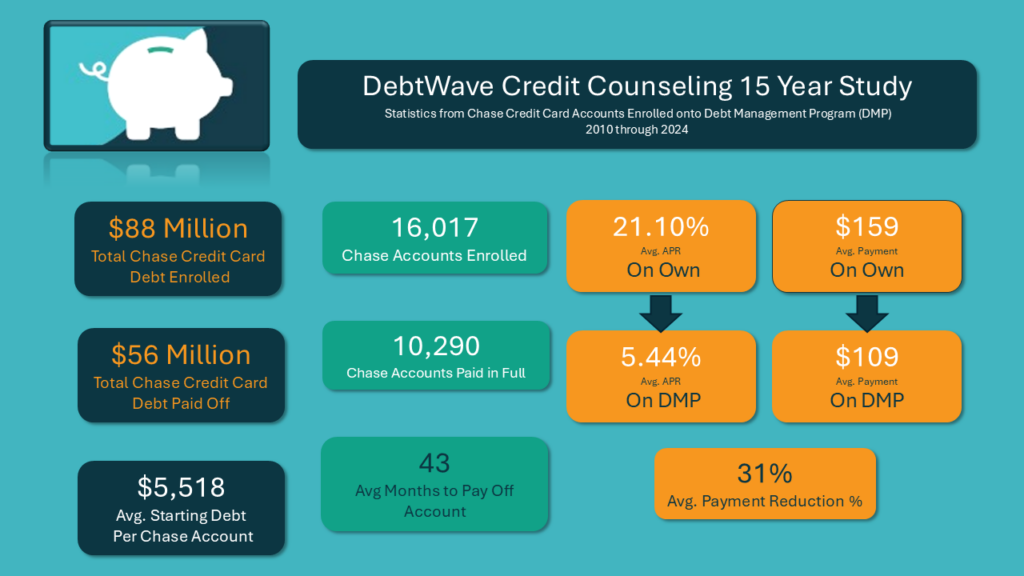
Historical DebtWave analysis of Chase credit card accounts enrolled from 2010 through 2024. The study included approximately $88 million in enrolled Chase debt, an average starting balance of $5,518 and an average payment reduction of 31%. Historical averages and outcomes do not guarantee future creditor terms or individual results.
Chase Hardship Program vs. a Debt Management Program
A Chase hardship program and a Debt Management Program may both help with payment pressure, but they serve different purposes. The key difference is whether you need assistance with a Chase account alone or a coordinated plan for several eligible creditors.
| Feature | Chase Payment Assistance | Debt Management Program |
|---|---|---|
| Who provides it? | Chase | Nonprofit credit counseling agency |
| Accounts addressed | Eligible Chase account | Multiple eligible participating creditors may be included |
| New loan required? | No | No |
| Payment or APR changes? | Depends on the account-specific option Chase offers | Depends on participating-creditor guidelines |
| Budget and debt review? | Not the primary purpose | Included in the counseling process |
Estimate Your Chase DMP Payment and APR
Use DebtWave's Debt Management Plan Calculator to compare your current Chase balance, monthly payment and APR with estimated DMP terms.
Calculator results are estimates. Actual Chase participation, payments and interest rates depend on the individual account and current creditor guidelines.
Why Consider DebtWave for Chase Credit Card Debt?
DebtWave Credit Counseling, Inc. is a 501(c)(3) nonprofit organization that has provided credit counseling, financial education and Debt Management Programs since 2001.
In addition, DebtWave is a member of the National Foundation for Credit Counseling. Chase's own educational resources say consumers who are struggling with debt may want to consider a reputable credit counselor or nonprofit debt management company.
Speaking with DebtWave does not require you to enroll in a DMP. A counselor can first review your Chase balance together with your other debts, monthly payments and household expenses.

NFCC Member Agency
DebtWave is listed in the National Foundation for Credit Counseling member-agency directory.
Chase Hardship Program FAQs
Does Chase have a hardship program for credit cards?
Chase currently identifies Card Payment Assistance Programs for existing card customers. To learn what may be available for your account, Chase instructs customers to call the number on the back of their credit card.
What number should I call about a Chase hardship program?
For Card Payment Assistance Programs, Chase directs existing customers to the number on the back of their card. Chase also currently lists 800-432-3117 as its general credit card customer service number.
Should I contact Chase before I miss a payment?
Contacting Chase early can give you an opportunity to ask about available payment-assistance options before the account becomes more difficult to manage. Use the number on the back of your card for account-specific information.
Can a Chase hardship program lower my monthly payment?
Chase does not publish one guaranteed reduced payment that applies to every cardholder. Any assistance or repayment terms depend on the specific account and the option Chase makes available.
Can Chase lower my credit card interest rate because of hardship?
Chase does not publish one universal hardship APR for all credit card customers. If Chase offers an account-specific arrangement, ask whether the APR changes and how long any modified terms remain in effect.
How long does a Chase hardship program last?
Chase does not publish one standard assistance period that applies to every credit card account. Therefore, ask how long any proposed arrangement lasts and what terms will apply afterward.
Does Chase discuss nonprofit credit counseling?
Yes. Chase's educational resources discuss nonprofit credit counseling and explain that a counselor may help consumers review their finances, create a personalized plan and consider a Debt Management Plan.
Can a Chase credit card be included in a Debt Management Program?
Eligible Chase accounts may be able to participate in a DMP. Participation and final creditor terms depend on the individual account and Chase's current program guidelines.
Will my Chase card be closed if it is enrolled in a DMP?
Credit card accounts included in a Debt Management Program are generally closed or restricted from new purchases. Specific treatment can vary according to creditor and account requirements.
Does a DMP settle Chase credit card debt for less than I owe?
Generally, no. A traditional Debt Management Program focuses on repaying enrolled balances. Debt settlement, by contrast, generally seeks to resolve debt for less than the full amount owed.
What if Chase is only one of several credit cards I owe?
A nonprofit credit counseling session can review several unsecured creditors together. This can be useful when your Chase payment is only one part of a larger monthly debt burden.
How can I estimate a Chase DMP payment?
Use DebtWave's Debt Management Plan Calculator to compare your current balance, payment and APR with estimated DMP terms. Actual creditor terms may differ from the estimate.
Get Help With Chase Credit Card Debt
If a Chase payment has become difficult, start by asking Chase about Card Payment Assistance Programs available for your account. When several credit cards are putting pressure on your budget, reviewing the complete debt picture may be more helpful than addressing only one balance.
DebtWave can provide a free financial review and help you compare your current repayment strategy with estimated Debt Management Program terms.
DebtWave Credit Counseling, Inc. is not affiliated with or endorsed by JPMorgan Chase Bank, N.A. Chase trademarks belong to their respective owner. Chase payment-assistance options, eligibility requirements and account terms may change. Debt Management Program eligibility, creditor participation, interest rates, payments and concessions vary by creditor and individual account. Historical results do not guarantee future outcomes. DebtWave is a 501(c)(3) nonprofit organization and does not lend money.