
If your U.S. Bank credit card payment has become difficult to manage, you may be searching for a US Bank hardship program that can make repayment easier. Fortunately, U.S. Bank offers ways for some customers to explore payment arrangements when they fall behind.
However, assistance from one creditor may not solve your entire debt problem. If you also owe money to Chase, Citi, Capital One, Discover, American Express, Synchrony, Wells Fargo, or other creditors, a DebtWave Debt Management Program may provide a broader solution.
Instead of looking only at your U.S. Bank balance, DebtWave can review your overall financial situation and eligible unsecured debts. As a result, you can compare creditor hardship assistance with a coordinated debt repayment plan.
Does the US Bank Hardship Program Offer Credit Card Payment Help?
U.S. Bank provides payment-assistance options for some credit card customers who have trouble making payments. For example, customers with a past-due credit card may see available payment-plan options when they sign in to U.S. Bank digital banking.
If U.S. Bank offers an arrangement, the customer can review the available options and choose the plan that best fits the situation. However, the exact choices depend on the account and U.S. Bank's current guidelines.
Therefore, you should not assume that every customer will receive the same payment, interest rate, fee treatment, or repayment period.
How to Check Your US Bank Hardship Program Options
U.S. Bank says eligible customers may see a message on their credit card account after signing in to digital banking. From there, you may have an opportunity to answer questions and review available payment-plan options.
If you do not see an assistance message, you can still contact U.S. Bank to discuss your situation. For personal credit cards, U.S. Bank currently lists 800-285-8585 for Cardmember Service.
Additionally, you can call the telephone number printed on the back of your credit card for account-specific assistance.
For current information, visit U.S. Bank's official credit card payment assistance page.
Questions to Ask About a US Bank Hardship Program
Before accepting any payment arrangement, make sure you understand how it changes your U.S. Bank account. A lower payment can provide immediate breathing room, but the long-term cost also matters.
First, ask what your new monthly payment will be and how long the arrangement lasts. Next, determine whether the interest rate changes during the program.
Finally, find out whether U.S. Bank will restrict or close the card and what happens when the assistance period ends.
Look Beyond the Monthly Payment
A smaller payment may sound attractive at first. However, you should also consider the interest you will pay and how long repayment may take.
Therefore, write down the terms of any U.S. Bank offer before enrolling. You can then compare those numbers with other repayment options.
When a US Bank Hardship Program Only Solves One Account
A creditor hardship program may work well when your U.S. Bank card causes most of your financial difficulty. However, many people struggling with one credit card also have balances with several other lenders.
For example, you might have U.S. Bank debt along with balances from Chase, Citi, Capital One, Discover, American Express, Synchrony, or other creditors. Consequently, reducing one payment may not lower your total monthly obligations enough.
Furthermore, contacting each creditor separately can result in several different payment arrangements, interest rates, due dates, and program requirements.

How DebtWave Can Help Beyond a US Bank Hardship Program
A Debt Management Program, or DMP, takes a broader approach. Instead of focusing on only your U.S. Bank account, a DebtWave credit counselor can review all of your creditors, balances, income, and expenses.
Then, DebtWave can determine which unsecured accounts may qualify for a debt management plan. Depending on creditor guidelines, participating creditors may provide reduced interest rates or other repayment concessions.
Most importantly, you can evaluate your debts together rather than trying to solve each account independently.
A Debt Management Plan Can Address Multiple Creditors
A traditional DMP does not replace your debts with a new consolidation loan. Instead, the program creates a structured way to repay participating unsecured creditors.
Qualifying clients generally make one monthly DMP payment. DebtWave then distributes the appropriate amounts to participating creditors according to the repayment plan.
Additionally, DebtWave can work with multiple creditors instead of concentrating only on U.S. Bank. Creditor participation, interest rates, and concessions can vary, so your counselor should review each account individually.
Repaying Your Debt Instead of Borrowing More Money
A Debt Management Program generally focuses on repaying the balances you owe rather than borrowing additional money. Therefore, you do not need to qualify for a new debt consolidation loan to explore a DMP.
Likewise, a traditional DMP differs from debt settlement because the goal is generally to repay enrolled balances rather than negotiate them down to a fraction of what you owe.
For many consumers, that distinction matters when comparing debt-relief strategies.
See Your Estimated U.S. Bank DMP Payment and APR
Before deciding between a US Bank hardship program and a DMP, it helps to compare the numbers. DebtWave's free Debt Management Plan Calculator can estimate what your payment and APR might look like.
The calculator includes estimates for U.S. Bank as well as many other major creditors. Therefore, you can enter several balances and see how a broader debt management strategy might compare with your current payments.
Although the results cannot guarantee exact creditor terms, they can provide a useful starting point.
Estimate Your Potential DMP Payment
Enter your credit card balances to see an estimated payment, APR, and potential monthly savings.
Compare a US Bank Hardship Program With Your Other Creditors
Your U.S. Bank balance may represent only part of your monthly debt payment. Therefore, consider how much you currently send to all of your credit card companies before choosing a solution.
For example, a reduced U.S. Bank payment may help, but high-interest balances with three or four other creditors could continue to strain your budget.
In contrast, a DMP may allow DebtWave to review those eligible accounts together. That broader view can make it easier to evaluate the total payment rather than one card at a time.
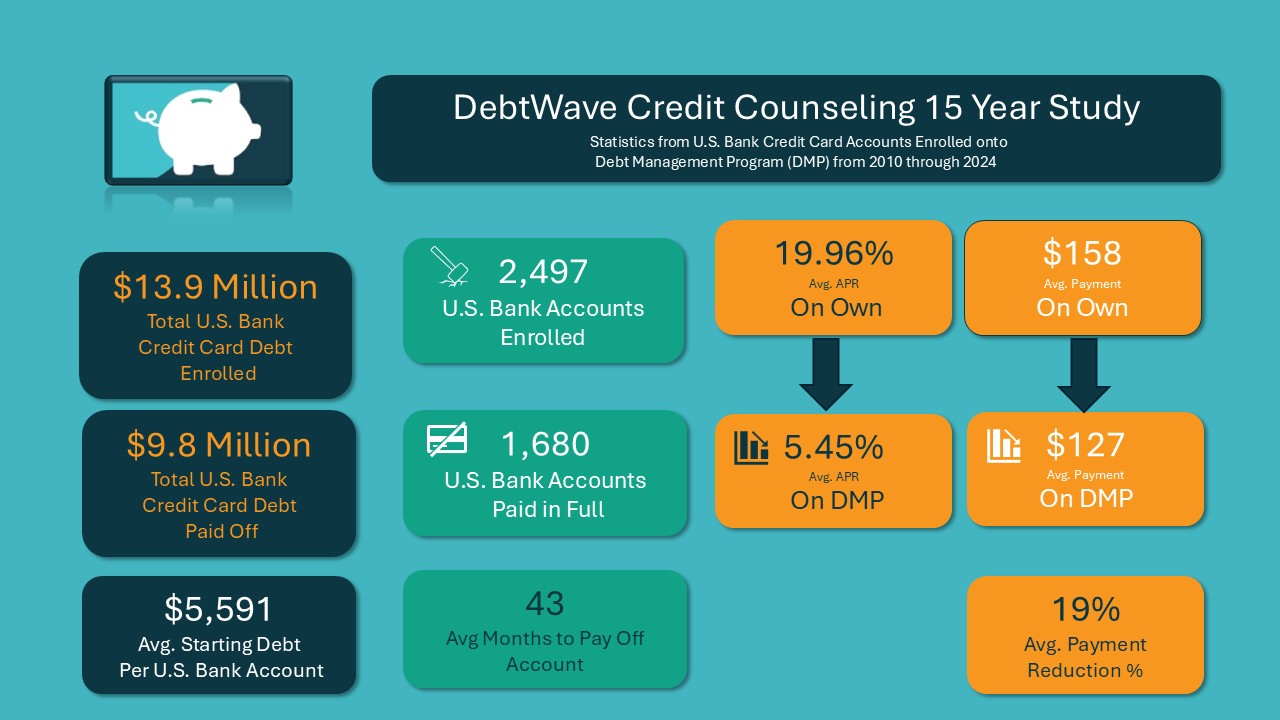
US Bank Hardship Program vs. Debt Management Program
Both approaches may help when credit card payments become difficult. However, they solve different problems.
| Option | U.S. Bank Assistance | DebtWave Debt Management Program |
|---|---|---|
| Accounts Reviewed | U.S. Bank account | Multiple eligible unsecured accounts |
| Who You Work With | U.S. Bank | DebtWave credit counselors |
| Payment Terms | Depend on the U.S. Bank offer | Depend on participating creditor guidelines |
| Monthly Process | Payment directly to U.S. Bank | One DMP payment for participating accounts |
| Primary Goal | Address the U.S. Bank account | Repay multiple enrolled debts through one structured plan |
Which Option May Work Better for Your Situation?
A U.S. Bank payment arrangement may make sense if that account creates most of your financial pressure. On the other hand, a DMP may deserve consideration when several credit cards contribute to the problem.
Additionally, the best choice depends on your budget, balances, interest rates, and available creditor terms. Comparing the total monthly payment can provide a clearer picture than focusing only on one interest rate.
Ultimately, the goal is to find a repayment strategy that you can realistically maintain.
Get a Personalized Review of Your Credit Card Debt
If the calculator suggests that a DMP may help, DebtWave can review your situation in more detail. You do not need to know whether you qualify before reaching out.
Instead, provide information about your U.S. Bank card and your other creditors. A counselor can then review your balances, budget, and potential debt management options.
Request Help From DebtWave
Complete the form below to learn more about your credit counseling and debt management options.
DebtWave Is an NFCC Member Agency
Choosing a nonprofit credit counseling organization is an important decision. DebtWave Credit Counseling is a member of the National Foundation for Credit Counseling (NFCC).
The NFCC maintains standards for member credit counseling agencies and counselor certification. Additionally, its member agencies work with creditors to help consumers evaluate debt repayment options.

How an NFCC Debt Management Plan Can Work With Creditors
NFCC member agencies can work with creditors when developing a Debt Management Plan. Therefore, DebtWave can review your U.S. Bank debt alongside your other eligible unsecured accounts.
However, not every creditor provides the same concessions. Interest rates, payments, program rules, and account eligibility can differ by creditor and account.
For that reason, DebtWave should review your specific creditor list before you rely on any estimated terms.
When to Consider More Than a US Bank Hardship Program
You do not have to wait until several accounts become seriously past due before reviewing your options. In fact, addressing the problem earlier may give you more time to develop a realistic repayment strategy.
Consider credit counseling if minimum payments consume too much of your monthly income. Similarly, a review may help when high interest charges prevent your balances from declining.
Moreover, managing several credit cards can make a coordinated repayment plan more valuable.
Signs a Debt Management Program May Be Worth Exploring
A DMP may be worth exploring if you can repay your debt but struggle with high interest rates or several separate payments. Additionally, one structured monthly payment may make your budget easier to manage.
You may also benefit from a review if your minimum payments continue to rise as balances grow. Consequently, comparing your current situation with estimated DMP terms may help you make a more informed decision.
US Bank Hardship Program Frequently Asked Questions
Does U.S. Bank Offer Credit Card Payment Plans?
Yes, U.S. Bank says some customers with past-due credit card balances can review payment-plan options through digital banking. However, available arrangements depend on the account and eligibility.
Who Should I Call About U.S. Bank Credit Card Payment Help?
U.S. Bank currently lists 800-285-8585 for personal credit card Cardmember Service. Alternatively, call the telephone number printed on the back of your card for account-specific assistance.
More US Bank Hardship Program Questions
What If I Do Not See a Payment Plan Online?
If no payment-plan message appears in digital banking, U.S. Bank says options may not currently appear for the account. However, you can still contact Cardmember Service and explain your financial situation.
Will Every U.S. Bank Customer Get the Same Hardship Terms?
No. Available assistance can depend on your account and circumstances. Therefore, ask U.S. Bank for the specific payment amount, duration, interest treatment, and other conditions before you enroll.
US Bank Hardship Program and Debt Management FAQs
Can a Debt Management Program Include U.S. Bank?
Potentially. DebtWave can review your U.S. Bank credit card along with your other eligible unsecured debts and determine what DMP terms may apply.
However, creditor participation and concessions can change. Consequently, calculator estimates should not replace an individual account review.
Can DebtWave Help With My Other Credit Cards Too?
Yes. DebtWave can review all of your creditors when evaluating your financial situation rather than concentrating only on U.S. Bank.
Depending on eligibility and creditor guidelines, a DMP may include multiple participating unsecured accounts.
Debt Management Questions to Consider
Will a DMP Forgive My U.S. Bank Balance?
A traditional Debt Management Program generally focuses on repaying enrolled balances rather than settling them for less than you owe. However, participating creditors may provide interest-rate or payment concessions that make repayment more manageable.
How Can I Estimate My U.S. Bank DMP Payment?
Use DebtWave's Debt Management Plan Calculator. The calculator can show an estimated U.S. Bank payment and APR along with estimates for other creditors you enter.
Take the Next Step Beyond a US Bank Hardship Program
A US Bank hardship program may provide meaningful assistance when your U.S. Bank credit card becomes difficult to pay. However, one creditor arrangement may not solve the problem if you have balances with several lenders.
Therefore, compare your U.S. Bank options with your complete debt picture. Start with the DebtWave Debt Management Plan Calculator to estimate what your payment and APR might look like.
Next, talk with DebtWave if you want help evaluating your U.S. Bank card alongside your other eligible creditors.
Important Information About Creditor Hardship Programs
Important: Creditor hardship programs, eligibility requirements, interest rates, payments, and debt management concessions can change.
Individual results vary by consumer, creditor, and account. DebtWave does not control U.S. Bank's hardship or payment-assistance terms.
DebtWave calculator results are estimates and do not guarantee creditor participation, interest rates, payment reductions, savings, or Debt Management Program eligibility.