

How to Read a Credit Card Statement and Understand What You’re Really Paying
Your credit card statement is more than a bill.
It tells you how much you owe, how much interest you’re paying, whether your balance is growing or shrinking, how long it could take to become debt-free, and whether your current repayment strategy is actually working.
Unfortunately, many people look at only two numbers:
Minimum Payment: How much do I have to pay?
Due Date: When do I have to pay it?
If you’re carrying credit card debt from month to month, there are several other numbers that may be far more important.
Understanding how to read a credit card statement can help you:
- Avoid late payments and unnecessary fees
- Identify fraudulent or incorrect charges
- Understand your credit card interest rate
- See how much interest you’re paying
- Determine how much of your payment is actually reducing your debt
- Understand how long minimum payments could keep you in debt
- Recognize when your credit card debt may be becoming difficult to manage
Let’s go section by section.
What Is a Credit Card Statement?
A credit card statement is a summary of your account activity during a particular billing cycle.
Credit card issuers typically provide a statement every month when there is account activity or a balance.
Depending on your card issuer and account settings, you may receive the statement by mail, electronically or through the creditor’s website or mobile app.
Although statement formats vary between banks, most credit card statements contain similar information.
You’ll typically find:
- Statement balance
- Minimum payment
- Payment due date
- Previous balance
- Payments and credits
- New purchases
- Fees
- Interest charges
- Credit limit
- Available credit
- APR
- Transaction history
- Minimum payment warning
- Rewards information
- Important account notices
If you’re trying to get out of credit card debt, don’t just look at what you owe.
Look at what your statement is telling you about how your debt is changing.
1. Find Your Credit Card Payment Due Date
One of the first things to locate is your payment due date.
This is the date by which your credit card issuer must receive at least the required minimum payment.
Missing a due date can potentially result in:
- Late fees
- Loss of promotional interest rates
- A penalty APR in certain circumstances
- Negative credit reporting if a payment becomes sufficiently delinquent
Setting up automatic payments for at least the minimum payment can help reduce the risk of accidentally missing a due date.
If possible, however, try to pay more than the minimum.
That brings us to one of the most important numbers on your statement.
2. Understand the Minimum Payment Due
The minimum payment is the smallest amount your credit card company requires you to pay for that billing cycle.
Paying the minimum generally keeps your account from being considered late.
But there’s an important distinction:
The minimum payment is not necessarily the amount you should pay. It’s simply the minimum your creditor requires.
When you carry a balance and pay only the minimum, interest can make repayment take considerably longer.
If you’re wondering why you’ve made your credit card payments faithfully for years but still owe a large balance, this may be part of the explanation.
3. Read the Minimum Payment Warning (Statement Requirement)
If you carry a credit card balance, this may be the most eye-opening section on your entire statement.
Look for a box labeled something similar to:
Minimum Payment Warning
Credit card issuers are generally required to show information illustrating the consequences of making only minimum payments.
Your statement may show:
- Approximately how long repayment could take if you make only minimum payments
- The estimated total amount you could pay
- An estimated monthly payment that could pay the balance off in approximately three years
- The potential savings compared with making minimum payments
Don’t skip this section.
Suppose you owe several thousand dollars and your statement tells you that making minimum payments could keep you paying the balance for many years.
That’s valuable information.
Your statement isn’t simply telling you what you owe this month.
It’s showing you what could happen if nothing changes.
Ask yourself:
Am I comfortable with the payoff timeline shown on my statement?
If the answer is no, it may be time to create a different repayment strategy.

4. Statement Balance vs. Current Balance: What’s the Difference?
These two numbers frequently cause confusion.
Statement Balance
Your statement balance is generally the amount you owed when your most recent billing cycle closed.
Current Balance
Your current balance reflects more recent account activity.
It can include:
- Purchases made after the statement closed
- Payments made after the statement closed
- Credits
- Returns
- Fees
- Other transactions
For example:
Your statement closes with a balance of:
$4,500
You then make another $200 purchase.
Your current balance may now be:
$4,700
But your statement balance remains:
$4,500
until the next statement is generated.
If a grace period applies to your account and you aren’t already carrying a balance subject to interest, paying your full statement balance by the due date can generally help you avoid interest on new purchases.
Check your cardholder agreement for the rules that apply to your particular account.
5. Review Your Previous Balance
Your previous balance is generally the balance reported on your last statement before accounting for subsequent payments, credits, purchases, interest and fees.
Comparing your balances from month to month can tell you something important.
Is your debt actually decreasing?
For example:
Last month’s balance: $8,200
This month’s balance: $8,050
You’re moving in the right direction.
But consider:
Last month’s balance: $8,200
This month’s balance: $8,475
If you’re making payments every month but the amount you owe continues increasing, investigate why.
It could be:
- New purchases
- Interest
- Fees
- Cash advances
- Balance transfers
- A monthly payment that isn’t large enough to overcome new charges
If this happens month after month, your credit card may be helping you survive the monthly budget rather than simply being used as a payment method.
That can be an early warning that your budget or debt payments need attention.
6. Find Your Credit Card APR (Hiding Somewhere on Your Statement)
APR stands for Annual Percentage Rate.
Your APR is one of the most important numbers to understand when you’re carrying credit card debt.
Your credit card may actually have several different APRs, including rates for:
- Purchases
- Balance transfers
- Cash advances
- Promotional balances
- Penalty rates
Don’t assume one interest rate applies to your entire balance.
Your statement should identify the APRs that apply to different types of balances.
7. Look at How Much Interest You Paid This Month
Finding your APR is useful.
Finding the actual interest charge can be even more powerful.
Look for a section labeled something similar to:
- Interest Charged
- Finance Charge
- Interest Charge Calculation
- Interest Charged This Period
Suppose your payment was:
$350
And your interest charge was:
$165
That means a substantial portion of the money you sent to the credit card company effectively went toward interest rather than reducing the underlying debt.
Your actual account calculation can be more complicated because payments, purchases, different APR balances and fees all affect the account. But looking at your monthly interest charge gives you a quick way to understand the cost of carrying the debt.
Now multiply that interest charge by 12.
If your interest charges are roughly $165 per month:
$165 × 12 = $1,980
That’s nearly $2,000 a year going toward interest at that approximate monthly rate.
Ask yourself:
How much faster could I pay off my credit card if less of my payment went toward interest?
This is one of the reasons consumers struggling with several high-interest cards sometimes investigate nonprofit credit counseling.
8. Review the Year-to-Date Interest Total on Your Statement
Many credit card statements also show the amount of interest and fees you have paid during the calendar year.
Don’t overlook it.
Seeing:
Interest charged this month: $165
may not seem as dramatic as seeing:
Interest charged year-to-date: $1,740
The year-to-date number puts the true cost of carrying your balance into perspective.
If you have several credit cards, repeat the exercise for every account.
For example:
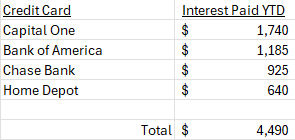
That’s $4,490 that didn’t go toward groceries, savings, retirement, vacations or other financial goals.
And more importantly, it shows why reducing high-interest debt can have such a meaningful effect on your finances.
9. Review Every Credit Card Transaction
Your statement contains a list of transactions made during the billing period.
Don’t assume every charge is correct.
Review the list for:
- Purchases you don’t recognize
- Duplicate charges
- Incorrect amounts
- Subscriptions you forgot about
- Memberships you no longer use
- Trial subscriptions that converted to paid plans
- Restaurants or merchants that charged an incorrect amount
- Returned purchases that weren’t credited
Small recurring expenses deserve attention too.
Five forgotten subscriptions costing $10 to $20 per month could be quietly consuming $600 to $1,200 or more per year.
What if you find a credit card charge you don’t recognize?
Contact your credit card issuer promptly.
Federal consumer protections provide a process for disputing certain credit card billing errors. There are important deadlines, so don’t wait several months before investigating an incorrect charge.
Your statement should provide instructions explaining where and how to report billing errors.

10. Check Payments and Credits
Make sure payments you’ve made are properly reflected on the account.
Also confirm that expected credits appear, including:
- Returned merchandise
- Refunds
- Promotional statement credits
- Rewards credits
- Billing adjustments
If a payment or credit is missing, contact your card issuer.
Don’t assume it will automatically correct itself next month.
11. Look for Credit Card Fees on Your Statement
Credit cards can carry a variety of fees.
Depending on the card and how it’s used, you might see:
- Annual fees
- Late-payment fees
- Balance-transfer fees
- Cash-advance fees
- Foreign-transaction fees
- Other account charges
Occasional fees may not seem significant.
But repeated fees make expensive debt even more expensive.
Review the fee section of every statement and understand what you’re being charged and why.
12. Know Your Credit Limit and Available Credit
Your statement may show your:
Credit limit: The maximum amount of credit available on your account.
Available credit: Approximately how much of that limit remains unused.
For example:
Credit limit: $10,000
Balance: $8,500
Available credit: approximately $1,500
A high balance relative to your credit limit can affect your credit utilization and may also signal that your finances are becoming increasingly dependent on borrowed money.
If several cards are close to their credit limits, don’t simply focus on finding another card.
Focus on why the existing balances aren’t decreasing.
13. Don’t Ignore Important Account Messages
Credit card statements can contain important notices from your issuer.
These may include information about:
- Changes to account terms
- Interest-rate changes
- Fee changes
- Promotional APR expiration dates
- Rewards program changes
- Automatic payment information
- Past-due account status
It can be tempting to ignore the fine print.
Don’t.
A 0% promotional balance becoming subject to a much higher standard APR, for example, could substantially change your repayment plan.
Use Your Credit Card Statement as a Debt-Payoff Tool
If you’re carrying debt, your statement shouldn’t just tell you how much to pay this month.
Use it to measure whether your financial situation is improving.
Each month, record these five numbers:
- Total Balance
- APR
- Minimum Payment
- Actual Payment
- Interest Charged
Do this for every credit card.
Then compare the numbers three months later.
Ideally, you want to see:
- Balances decreasing
- Less money going toward interest
- No new late fees
- Less reliance on available credit
- A shorter projected payoff period
If that’s happening, keep going.
But what if you’re making payments and the numbers aren’t improving?
That’s where your credit card statement becomes more than a bill.
It becomes a warning.
5 Credit Card Statement Warning Signs You Shouldn’t Ignore
Understanding your statement can help you recognize when credit card debt is becoming difficult to manage.
Consider taking a closer look at your repayment strategy if:
1. Your balance barely changes after you make a payment
You send hundreds of dollars to your creditor, but your balance decreases by only a small amount.
High interest charges may be consuming a significant portion of your payment.
2. You regularly make only minimum payments
Making the minimum keeps the account current, but it may create an extremely long repayment period.
Read your Minimum Payment Warning.
The estimated payoff timeline may surprise you.
3. Your balance increases even though you’re making payments
This usually means new purchases, interest and fees are exceeding the amount of debt you’re paying down.
4. Several credit cards are close to their limits
One high balance may be manageable.
Multiple high-balance cards can indicate that your overall debt is becoming increasingly difficult to control.
5. You’re using your card for necessities because your payment consumed your paycheck
This can create a cycle:
Pay credit card → Run short of cash → Use credit card → Receive next statement → Pay credit card again
You may be making every payment on time while never making meaningful progress.
If that sounds familiar, you may need more than a larger monthly payment.
You may need a different strategy.

When Should You Consider Credit Counseling?
Credit counseling isn’t only for people who have already stopped making their credit card payments.
In fact, many people seek help while they’re still completely current.
They simply realize the math isn’t working.
Consider speaking with a nonprofit credit counselor if:
- You have several high-interest credit cards
- Most months, you can only afford the minimum payments
- Your balances aren’t decreasing
- Interest consumes a large portion of your payments
- Managing multiple due dates has become difficult
- Credit cards are being used to cover basic living expenses
- Missing a payment soon seems increasingly likely
- Your statement shows it could take many years to become debt-free
A credit counselor can look beyond one credit card statement and review your entire financial picture.
What Happens During Credit Counseling?
During a credit counseling session, a counselor can review your:
- Income
- Monthly household expenses
- Credit card balances
- Interest rates
- Monthly payments
- Other financial obligations
At DebtWave Credit Counseling, the initial credit counseling session is free.
The goal is to determine what options may realistically help you pay off your debt.
You aren’t required to enroll in a Debt Management Program simply because you speak with a counselor.
Depending on your situation, you may be able to pay the cards off yourself with a better budget or repayment strategy.
For consumers with multiple high-interest credit cards, another option may be a Debt Management Program.
What Is a Debt Management Program?
A Debt Management Program, or DMP, is a structured way to repay eligible unsecured debt.
It is not a debt consolidation loan.
You aren’t borrowing new money to pay off your credit cards.
Instead, participating creditors may provide repayment concessions according to their individual program guidelines, which can potentially include:
- Reduced interest rates
- Reduced monthly payments
- Waived or reduced fees
You make your scheduled program payment, and the credit counseling organization distributes payments to participating creditors included in the plan.
Debt Management Programs typically aim to repay enrolled credit card debt within approximately three to five years, although individual repayment periods vary.
Your Credit Card Statement Can Tell You When It’s Time for a Change
Go back to your most recent statement.
Find these four numbers:
1. Balance: $________
2. APR: ________%
3. Monthly interest charged: $________
4. Minimum-payment payoff estimate: ________ years
Now do the same thing for every credit card you have.
Add up all of your outstanding balances.
Next, calculate your total minimum monthly payments.
Finally, determine how much interest you were charged across all of your cards this month.
Then ask one final question:
If I continue doing exactly what I’m doing today, am I satisfied with when I’ll become debt-free?
If the answer is yes, you have a plan.
When the answer is no, don’t ignore what your statements are telling you.
Get a Free Credit Counseling Session
Understanding how to read a credit card statement is an important step.
But understanding the statement doesn’t automatically make high-interest debt easier to repay.
If you’re struggling with multiple credit cards, DebtWave Credit Counseling can help you review the numbers and determine whether there may be a more effective way to pay off your debt.
DebtWave is a nonprofit credit counseling organization that has helped consumers with credit card debt since 2001.
A credit counseling session can help you understand:
- How much you actually owe
- How much you’re paying in interest
- Whether your current payment strategy is working
- How long repayment may take
- Whether a Debt Management Program may be an option
The initial credit counseling session is free, and there is no obligation to enroll in a Debt Management Program.
If your credit card statements are showing you that your balances aren’t going down fast enough, now may be a good time to find out what other options are available.
Call DebtWave at (888) 686-4040 or get started online for a free credit counseling session.