

Perhaps, you skipped school the day they taught "How Does Interest Work with Credit Cards". Well, not likely.
Interest rates can be a big nuisance to our finances. It would sure be nice if everyone was required to know how to calculate interest in order to graduate high school. After all, it would save us thousands of dollars and eliminate tons of financial stress. But unfortunately, most of us learn the answer the hard way. We learn this when it’s too late. Usually after racking up thousands of dollars in credit card debt. At that point, we understand that interest rates serve as a major roadblock on our journey to paying back our debt.

What is credit card interest?
Simply put, it’s the price we pay for borrowing money. Think of it as a fee you pay for having debt. Or the punishment for spending money you don’t have. Each credit card has an interest rate or annual percentage rate (APR). And in some cases, you may have multiple APRs. One for purchases, one for cash advances and perhaps one for balance transfers.
How Does Interest Work with Credit Cards?
Here’s the complicated part for those that hate math. The interest is calculated daily but appears on your statement as a monthly finance charge. In summary, an ANNUAL percentage rate get calculated DAILY but charged MONTHLY. Are the banks trying to confuse us on purpose? Possibly.
Credit cards typically have 12 different statement periods each year. With 365 days in a year (or 366 every four years), each period varies on the number of days in it. Some can have 30 and some may have 31.Then you have your balances moving up and down like a hotel elevator. Therefore, your finance charges will vary from month to month.

It's crucial to keep track of your APRs on your cards and to know what your monthly finance charge is each month. Because each time you make a monthly payment, you need to know how much of that goes toward interest. The higher the interest is, then it’s more likely that most of your payment is going toward just interest. This scenario makes it difficult to pay off your debt.
Example of calculating finance charges on credit card debt
Let’s take an example of someone who has $20,000 of credit card debt with an APR of 24%. To calculate their monthly finance charge, let’s convert their APR into a daily rate. 24% divided by 365 comes out to a daily rate of .065%. Next, multiply the $20K by .065%. This comes out to $13. Then take that $13 and multiply it by 30 days (assuming your statement period is 30 days). We get $390 as the total monthly finance charge. In other words, you are being charged $390 every month to borrow $20K.
Now look at the monthly payment that you normally send. Let’s say it’s $500. Each time you send $500, the bank takes $390 in interest charges. Therefore, only $110 goes toward the balance. It’s quite painful to see. But can motivate a positive change for some people.
Use a Spreadsheet to Calculate Your Credit Card Interest
Whether you prefer Microsoft Excel or Google Sheets, using a spreadsheet provides a great visual to help understand your situation much better. Let's go over the steps in creating this sheet:
First, create your column headers. These will be the names of each column. Click on cell B7 and type "Creditor Name". To the right, you have cell C7. Type "Balance". Continue to the right with "APR". Then "Payment", "Finance Charge" and finally "Principal Payment" in cell H7.
Next, we can enter the information of your first creditor in the row below starting in cell B8. Start with the name of your creditor such as Chase or Bank of America. Then enter the balance of that account followed by the APR and payment. For the finance charge, we will enter a formula. Type in =SUM(D8*E8)/12. This is a slightly different formula than what we used above. This formula gives us a monthly estimate of finance charges rather than the daily charges added up for the statement period. In other words, this may not match your statement perfectly but will come close.
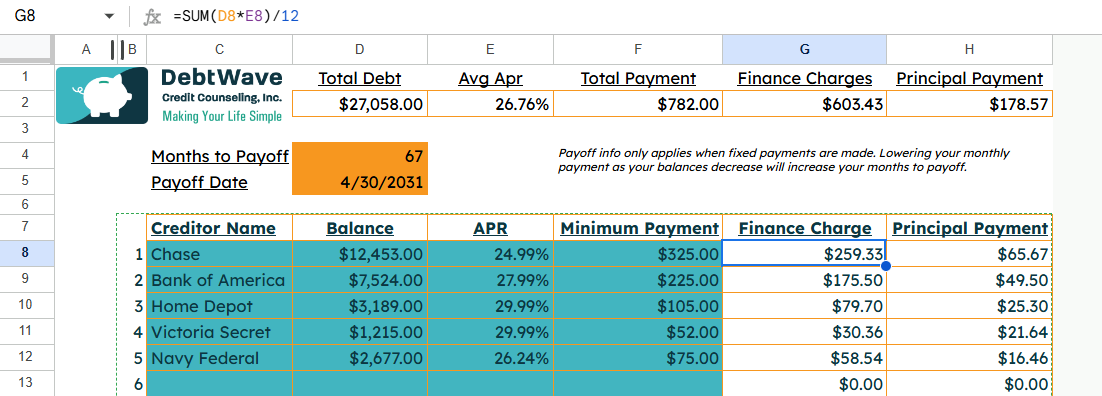
And finally, let's enter another formula for cell H8. This is simply the difference between your Payment and Finance Charge. Enter =SUM(F8-G8) into this cell.
Now move onto creditor #2. Then enter the name, balance and so on. Copy the formulas in cells G8 and H8 and paste them to G9 and H9. Continue this for each creditor.
Instead of creating your spreadsheet from scratch, download our google sheet template.
How can you lower your rates on credit cards?
The most popular ways to lower interest rates are through a debt consolidation loan, balance transfer, hardship programs offered directly by the creditors or credit counseling. Be sure to understand the pros and cons of each credit card consolidation service.
What do interest rates, credit scores and net worth have in common?
They are the most important numbers in personal finance. They also require some intimidating math or formulas in order to get the final result. The more time you can spend understanding these numbers, the better off your personal finances will be.
