
If a Target Circle Credit Card or Target Mastercard payment has become difficult to afford, you have options worth reviewing before you simply miss a payment.
Fortunately, Target Card Services can discuss your account, while nonprofit credit counseling can help you compare a longer-term repayment plan across multiple debts.
In addition, DebtWave's free Debt Management Plan Calculator can estimate what your Target payment and APR might look like on a DMP.

What Is the Target Circle Credit Card?
Target RedCard is now called Target Circle Card, although many cardholders still search for the old name.
Importantly, TD Bank USA, N.A. issues the Target Circle Credit Card and Target Mastercard, while Target Corporation issues the Target Circle Debit Card.
Therefore, this article focuses on the credit products that can carry revolving debt, not the debit card.
Target Circle Card also provides a 5% discount on eligible Target purchases. However, interest charges can outweigh that benefit when you carry a balance for months.
Why Target Credit Card Debt Can Become Expensive
Target's current public credit application lists a 28.45% variable purchase APR for new Target Credit Card and Target Mastercard accounts, although rates can change.
Because your actual APR may differ, check the rate on your latest statement before comparing repayment options.
Therefore, reducing a high APR can matter just as much as lowering the monthly payment.
Does Target Have a Hardship Program?
Target's public help pages do not describe one standardized Target Hardship Program with a guaranteed reduced payment, APR, or duration for every cardholder.
Instead, they direct credit-card customers to Target Circle Card Guest Services for account questions and servicing.
Because assistance can depend on your account and circumstances, ask specifically what payment-assistance or hardship options are available before agreeing to new terms.
Important: Do not assume they will offer every cardholder the same payment reduction, interest rate, fee waiver, or repayment period.
Instead, ask for the exact terms available for your account and compare them with your other debt-repayment options.
How to Ask Target for Credit Card Hardship Assistance
If you are worried about an upcoming payment, contact Target Circle Card Guest Services at 1-800-424-6888 for the Target Credit Card or U.S. Target Mastercard.
Before calling, gather your current balance, APR, minimum payment, monthly income, and essential expenses.
Then explain the financial change that made the regular payment difficult and ask the representative to review available account-assistance options.
Questions to Ask Before Accepting a Payment Arrangement
- What will my new required monthly payment be?
- Will the APR on my Target account change?
- How long does the proposed arrangement last?
- Are late fees or other charges reduced or waived?
- Could Target or TD Bank restrict or close the account?
- How might the arrangement affect credit reporting?
- What happens if I cannot make an agreed payment?
Estimate Your Target DMP Payment & APR
A phone call can tell you what they may offer directly; however, it does not show how a nonprofit Debt Management Program might compare.
Therefore, use the calculator below and select Target from the creditor list.
Next, enter your current balance, APR, and minimum payment to see an estimated DMP payment and APR.
Because calculator results are estimates, review current creditor terms before you enroll.
What If Target's Payment Assistance Isn't Enough?
If Target is only one of several high-interest cards, solving one payment may not solve your overall budget.
Instead, a nonprofit Debt Management Program can organize eligible unsecured debts into a structured repayment plan without requiring a new consolidation loan.
Moreover, participating creditors may offer lower interest rates or payments, although creditor terms can change and no result is guaranteed.
Can a Target Credit Card Be Included in a Debt Management Program?
A Target credit-card account may qualify for a Debt Management Program depending on current creditor participation terms and the details of the account.
In addition, a DMP can potentially include other eligible unsecured debts, which may make it more useful when they are only part of the problem.
The Consumer Financial Protection Bureau explains how credit counseling and debt management plans work, including how consumers can make one payment to a credit counseling organization for participating creditors.
How a Debt Management Program Works With Target Debt
Review Your Debts
First, a DebtWave counselor reviews your balances, APRs, minimum payments, income, and living expenses.
Identify Eligible Accounts
Next, the counselor identifies eligible creditors and estimates the payment required for a DMP.
Compare the Numbers
Afterward, you can compare those estimates with your current payments before deciding whether to enroll.
Make One Scheduled Program Payment
If you enroll, DebtWave collects your scheduled program payment and distributes funds to participating creditors.
Work Toward Paying Off the Debt
Finally, you continue repaying the balances you owe while following a structured path toward paying off eligible debts.
DebtWave's Historical Results With Target Accounts
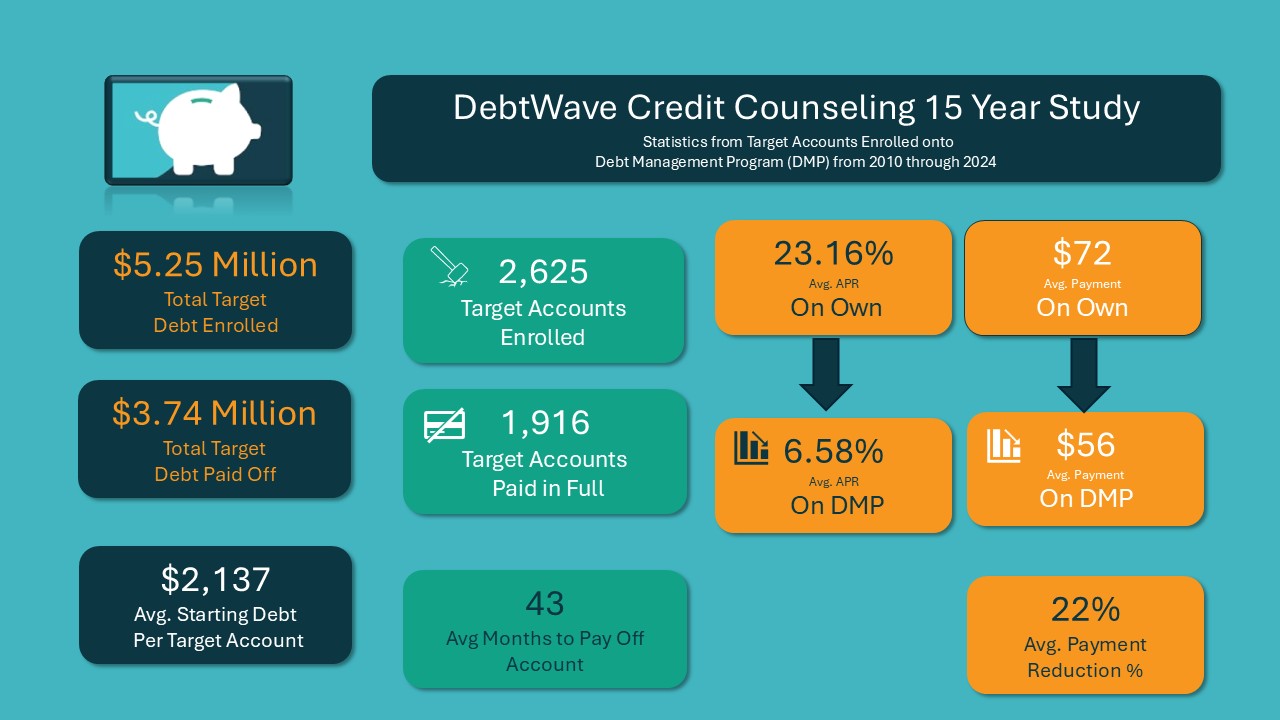
DebtWave reviewed all accounts enrolled in its Debt Management Program from 2010 through 2024.
During that 15-year study, 2,625 Target accounts entered the program, and 1,916 accounts reached paid-in-full status.
In addition, the study covered $5.25 million in starting debt and $3.74 million in debt paid off.
What Do the Historical Target Results Mean?
Historically, the average starting Target balance was $2,137, while the average APR fell from 23.16% before enrollment to 6.58% on the DMP.
Likewise, the average payment changed from $72 to $56, which represented a 22% average reduction.
Finally, the average payoff time was 43 months.
Historical results are not guaranteed. These numbers describe past DebtWave accounts rather than a promise of current Target terms.
Because creditor policies and individual accounts differ, use the calculator or speak with a counselor for a current estimate.
Can You Pay Off Target Credit Card Debt on Your Own?
A DMP is not the only way to repay Target credit card debt.
For example, you may be able to make faster progress by stopping new purchases, building a realistic budget, and paying more than the minimum whenever possible.
However, a high APR can make that strategy difficult when a large share of each payment goes toward interest.
Build Your Own Target Credit Card Payoff Plan
Start by listing every credit card balance, APR, minimum payment, and due date.
Then choose either a highest-interest-first strategy or a smallest-balance-first strategy that you can follow consistently.
Finally, review your progress each month and adjust your budget when income or expenses change.
Target Hardship Program vs. Debt Management Program
Working directly with Target may make sense when that account is your main problem and an account-specific arrangement fits your budget.
On the other hand, a DMP may be more useful when you have several eligible credit cards and want one structured repayment plan.
Either way, compare the payment, APR, duration, fees, account restrictions, and total amount repaid before choosing.
| Feature | Target Account Assistance | Debt Management Program |
|---|---|---|
| Who provides it? | Target Card Services / TD Bank | Nonprofit credit counseling organization |
| Accounts covered | Your Target credit-card account | Multiple eligible unsecured creditors may qualify |
| New loan required? | No | No |
| Monthly payment | Depends on the account-specific assistance offered | Depends on participating creditor terms |
| Interest rate | Depends on Target's account-specific offer | Participating creditors may provide reduced APRs |
| Payment structure | Arrangement directly on the Target account | One scheduled program payment for participating debts |
| Potential fit | Target is your primary debt problem | Several unsecured debts need attention |
Target Hardship Assistance vs. Debt Settlement
Debt settlement is different from both a creditor hardship arrangement and a Debt Management Program.
Typically, settlement companies try to negotiate payment for less than the full balance, often after accounts become delinquent.
By contrast, a DMP focuses on repaying participating balances through structured payments and available creditor concessions.
Because settlement can involve missed payments, collection activity, credit damage, potential lawsuits, and possible tax consequences on forgiven debt, compare alternatives carefully.
Therefore, consumers who can afford a structured repayment plan may want to review hardship assistance or nonprofit credit counseling first.
When Should You Talk With a Credit Counselor?
Consider a free credit counseling session when minimum payments no longer fit your budget, several accounts carry high APRs, or you are borrowing from one source to pay another.
Similarly, counseling can help when you are current on payments but can see that balances are not falling fast enough.
Most importantly, you can review the numbers before deciding whether a DMP makes sense.
See What Your Target Payment & APR Could Be
Enter your balance, current APR, and monthly payment into DebtWave's free Debt Management Plan Calculator to see an estimated DMP payment and interest rate.
No new loan. Free estimate. No obligation to enroll.
Frequently Asked Questions About the Target Hardship Program
Does Target offer a hardship program?
Target's public help pages do not publish one universal hardship plan with guaranteed terms for every Target Circle Credit Card or Target Mastercard account. However, cardholders can contact the Circle Card Guest Services and ask what payment-assistance options are available for their specific account.
Who issues the Target Circle Credit Card?
TD Bank USA, N.A. issues the Target Circle Credit Card and Target Mastercard. Meanwhile, Target Corporation issues the Target Circle Debit Card, which does not create the same type of revolving credit-card debt.
Is Target RedCard now Target Circle Card?
Yes. They renamed RedCard as Target Circle Card, so existing RedCard customers may see the newer Target Circle Card branding even though they still think of the account as a RedCard.
How do I contact Target about a payment I cannot afford?
Call their Guest Services at 1-800-424-6888. Before you call, gather your balance, APR, minimum payment, income, and essential expenses so you can discuss your situation clearly.
Can a Target credit card be included in a Debt Management Program?
A Target credit-card account may qualify for inclusion in a Debt Management Program depending on current creditor participation terms and the details of the account. Therefore, use DebtWave's calculator for an estimate and speak with a counselor if you want a complete review.
What APR could I receive for Target on a DMP?
The calculator estimates a possible DMP payment and APR based on current program data, but it does not guarantee creditor terms. Because rates and eligibility can change, a counselor should confirm the available terms before you enroll.
Does using the DMP calculator affect my credit score?
No credit check is required simply to use DebtWave's Debt Management Plan Calculator. Instead, you enter your creditor, balance, APR, and current payment manually.
Will my Target credit card close on a Debt Management Program?
Creditors commonly close or restrict revolving credit cards that enter a Debt Management Program, which helps prevent new charges while balances are repaid. However, your counselor can explain what to expect for each account before enrollment.
Can a Target Circle Debit Card go on a Debt Management Program?
No. This card draws from a linked bank account and is not a revolving credit-card balance, so it is not the type of debt included in a DMP.
Is DebtWave affiliated with Target or TD Bank?
DebtWave Credit Counseling, Inc. is an independent nonprofit credit counseling organization and is not affiliated with Target Corporation or TD Bank USA, N.A. Therefore, Target controls its own account-assistance policies, while DebtWave can explain separate credit-counseling and DMP options.
Compare Your Target Credit Card Repayment Options
You do not need to wait until your account becomes seriously delinquent to understand your options.
Instead, compare any assistance they offer with your estimated Debt Management Program payment and determine which approach better fits your budget.
Free nonprofit credit counseling. No new loan. No obligation to enroll.